
Indian Relay Racing has been a part of Gayle Skunk Cap’s life for decades.
His first hands-on taste of the sport was back in the 1980s when his late uncle, Leroy Skunk Cap,
introduced him, in Montana, to what is sometimes called the original extreme sport.
“He immediately recognized what an exciting and unique event it was,” said Gayle, who is the announcer for the Indigenous Celebration Presented By Ovintiv this weekend at Evergreen Park. “He believed it would be a great addition to Montana rodeos and worked to bring it to the state.”
While he never competed as a rider, Gayle has had a big impact on sport as one of the top announcers in North America.
ALBERTA ON HIS ANNOUNCING CARD
He will do up to 12 events per year from May to September and has been the voice at Indian Relay Racing in other Alberta locations including Blood Tribe in Standoff; Rocky Mountain Turf Club in Lethbridge; the Siksika INFR Tour Rodeos in Gleichen; the Tsuu-tina Nation INFR Tour Rodeos in Sarcee; and events in Enoch Cree Nation.
Last weekend he was calling the races at a competition in Montana.
He grew up around the sport staring out by helping his uncle train relay horses when he was a youngster.
“Those experiences gave me a deep appreciation for the dedication, horsemanship, and teamwork that Indian relay racing requires,” he said. “While I never competed as a rider, being involved behind the scenes and later becoming an announcer allowed me to stay closely connected to the sport and its rich traditions.”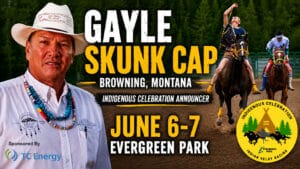
About 20 years ago he got his first taste of announcing at the at the North West Montana Fair in Kalispell, MT – one of the prominent relay events at the time.
In addition to announcing, he worked as a digital music mixer, blending a variety of musical genres for the INFR Tour rodeos, PRCA rodeos, and Powwows.
“These experiences helped me develop a strong connection to the sport, the culture, and the teams involved. It also kept the crowd engaged.”
MUSIC BIG PART OF RACING NOW
When he first started, many rodeos were just beginning to incorporate music into their productions, and many Indian rodeos had not yet adopted that approach.
“I was among the early pioneers who helped bring music into the downtime between events, creating diverse music mixes that added energy and entertainment for both competitors and spectators. It was exciting to be part of that evolution and to help shape the atmosphere that has become common at rodeos today.”
Being a sought-after announcer gives him the opportunity to travel to various events, like this weekend’s at Evergreen Park, to provide race commentary and to help keep the spectators informed of the race taking place.
“It also keeps them engaged with excitement while showcasing the tradition of Indian relay racing,” says Gayle, who is sponsored by TC Energy in Grande Prairie at the 2026 Indigenous Celebration..
His family is now three generations deep in Indian Relay and has been involved in producing one of the sport’s premier events—the Muckleshoot Gold Cup in Washington. The Gold Cup is widely recognized across the sport as “the big show”.
 “Teams know the level of competition it represents, and only those with consistent winning records and strong performances throughout the season are selected as invited teams to compete,” he says. “Being part of an event with that kind of prestige, while also seeing my family’s involvement span three generations, is something I take a lot of pride in.’
SEVEN STATES AND TWO PROVINCES
Indian Relay Racing started as a regional sport and has expanded tremendously. It is now featured in seven states and two provinces.
“I am truly amazed and ecstatic about how far Indian Relay Racing has grown over the years. Seeing that growth has been incredible. One of the things that amazes me most is how the sport was introduced at the Indigenous Games to showcase it to the western provinces of Canada. A lot of that exposure can be credited to Harvard Bingo Moran, who played a significant role in promoting and expanding Indian relay racing.”
With that popularity has come changes.
“The biggest change I’ve seen in Indian relay racing since I started announcing has been the growth in purse money and the overall investment in the sport. Back in the 1980s, relay events typically offered around $10,000 to $12,000 in prize money. At the time, that was considered a good purse.
“Today, the sport has grown tremendously featuring purses in the $70,000 to $80,000 range. That kind of growth reflects the increasing popularity of the sport, the dedication of organizers and sponsors, and the commitment of the riders and teams who continue to elevate the competition.”
He said it is remarkable to see how far sport has come, from its early days to becoming a major attraction that draws large crowds, top competitors, and significant prize money throughout the relay season.
He has many family members and relatives who are involved in the sport. They travel together and support each other. He says it is a family-centred sport.
“Indian relay is more than just competition—it’s a way of life. Families often pack up, attend the events together, and camp right alongside their horses. That close connection between family, community, and the horses is a big part of what makes the sport so special and unique.”
CANADIAN RACES MORE OF A CHALLENGE
The races in Grande Prairie this weekend might prove to be a little more interesting for him than the ones in Montana last weekend.
“It can definitely be challenging in Canada,” he said. “Riders are allowed to compete shirtless, which can make it harder for announcers and judges to identify teams when they’re at a distance. Unlike in the United States, where riders are required to wear their team colors, the lack of consistent visual identifiers can make it difficult to quickly distinguish who is who during fast-paced exchanges. With so much happening at once in Indian relay, especially during the exchange, it takes good eyes and a lot of experience to accurately know the teams to keep the audience informed.”
“A lot of the designs on their shirts designate their family history and although some may be contemporary, but it is also known as a trademark as to where you can immediately recognize who that team is and who that design belongs to. Just like in basketball, hockey, and many other sporting events they have their trademark designs to identify who they are representing.”
He says he will continue to announce as long as he is able to, and the travel demands don’t take too much of a toll on him.
“Right now, I still feel I have a valuable role to play. I’m able to contribute experience and input at many different events I attend each year, and I enjoy being part of the growth and continued success of Indian relay racing.”
Gayle is a member of the Blackfeet Tribe and has five children. He owns a ranch west of Browning, Montana and manages Wind Dancer Tunes – a sound digital business.
But, most importantly for Grande Prairie relay racing fans, he is an outstanding Indian Relay Racing announcer.